Here In My Home - Malaysian Artistes For Unity

Friday, 8 June 2007

THE MALAY NAVY IN WORLD WAR II

The Royal Malaysian Navy can trace its roots to the formation of the Straits Settlement Naval Volunteer Reserve (SSNVR) in Singapore on 27 April 1934 by the British colonial government in Singapore. The SSNVR was formed to assist the Royal Navy in the defence of Singapore, upon which the defence of the Malay Peninsula was based. In the colonial era the British only knew too well the importance of the Straits of Malacca and the South China Sea and it is no surprise then that they made Singapore a bastion of their presence in the region. Another reason behind its formation was political developments in Asia, particularly Japanese that was increasingly assertive in Asia. They were keen to mount a volunteer service corps comprising of locals and the Straits Settlement Naval Volunteer Reserve (SSNVR) came into being on 27th April 1934.


HMS Laburnum, The Pride of MRNVR

The first SSNVR ship, HMS Laburnum was inducted on 18 February 1935 and was used as a naval training platform. She was an ex-royal New Zealand Navy 2000 ton Flower class corvette fitted with a three-pounder gun and a 4.7-inch gun. HMS Laburnum was later converted to the HQ and Administrative Centre for the SSNVR, and the smaller HMS Penyengat was brought in for seamanship and navigational training. By 1937, two motor launches HMS Panglima and HMS Pahlawan, equipped with Lewis guns, were commissioned for coastal patrols. The SSNVR was expanded in October 1938 when its Penang branch was established. Initially known as SSNVR Penang, it was later designated as the Malayan Naval Volunteer Reserve (MRNVR) and received HMS Panji, transferred from Singapore, for training purposes. However by 1940 MRNVR had acquired two additional patrol boats, HMS Trang and HMS Jerong and five minesweepers. These reservists were in essence local volunteers , comprising almost entirely of Malays whose recognition of their service has largely gone unrecognised.With the outbreak of the Second World War in Europe, the SSNVR increased the recruitment of mainly indigenous personnel into the force, to beef up local defences as Royal Navy resources were required in Europe. Members of the SSNVR were called up to active duty, and the force was augmented by members of the Royal Navy Malay Section.


With the winds of war blowing stronger, the British government had formed the Malay Section of the Royal Navy (RN) in 1939. This was the colonial government's effort to beef up the RN's power to defend the coastal waters of the Peninsula and the British Empire's interests in the archipelago, including Sarawak, North Borneo and Labuan. This was a separate unit of the Royal Navy and these men were given rigorous training in seamanship, communications and gunnery whilst shaping them into a fighting unit.This section, affectionately known as the Malay Navy, comprised exclusively of Malay men amongst the ranks as the RN was impressed with the will, abilities and service spirit of the Malay youths in the Malayan Royal Navy Volunteer Reserve (MRNVR). They comprised of fresh recruits and a number of MRNVR members mobilised into the new force. The section's training centre and barracks were established at HMS Pelandok, tucked inside the sprawling naval base in Singapore. Under the command of Lt.-Commander H. Vickers, the recruits were trained as telegraphists, seamen and signal visualisers before serving on board RN ships, mostly merchantmen hastily converted and armed for combat. These ships were part of 80 warships the RN had for the defence of Malaya against the Japanese, with the battleship HMS Prince of Wales and battle cruiser HMS Repulse leading the fleet.


The RN was however shocked on 2 December 1941 when these ships were sunk by Japanese warplanes, exposing the RN's fleet weakness against air attacks since there was no effective air cover available. Eleven days after the sinking of the capital ships, the HMS Lipis was sunk in Sarawak waters. By January 1942, the RN suffered further casualties with HMS Kudat sunk in Klang harbour, HMS Surveyor in Pulau Besar and HMS Kampar in the South China Sea. Meanwhile on 13 January 1942, HMS Matahari and HMS Larut were sunk by Japanese aircraft near Pulau Sabang while withdrawing from Malaya. The survivors who swam to the island were later rescued by HMS Kedah, which was heading towards Java Island after evacuating Borneo waters. In Singapore, HMS Pelandok was initially bombed on 8 December 1941 but was later destroyed in January 1942 by Japanese air raids. All able-bodied survivors were then moved to HMS Laburnum to join members of the MRNVR there. However, HMS Laburnum herself was damaged by the Imperial Japanese Navy on 11 February 1942 and was scuttled four days later at the Fall of Singapore to avoid her capture by the Japanese. By this time, all surviving ships were ordered to make a break from the harbour and sail for Australia via Indonesia, and for Colombo. Of the Malay seamen left behind in Singapore, 25 were killed by the Japanese in Tanjong Pagar after the surrender while the rest were sent as force labourers to Siam, Burma and Indonesia although some managed to escape to their kampongs.

Meanwhile, most of the ships escaping to Australia were sunk by the Japanese who were waiting in ambush in the south of Singapore. HMS Vyner Brooke was sunk by 9 Japanese Bombers on 14 February off Pulau Bangka with 20 Malay seamen dead. HMS Hwang Ho with Lt.-Commander Vickers was sunk off Lingga and he and his crew were taken as prisoner of wars (POW's) to Pulau Bangka where he later died. Sister ships HMS Siang Wo and HMS Shu Kuang were sunk on the same day but the survivors from the latter ship managed to reach Padang Sumatra where they were evacuated by the light cruiser HMS Dauntless to Chelicap Java. There, the Malay survivors joined those on board HMS Kedah that now headed towards Colombo as the way to Australia was no longer safe. Unfortunately after two days sailing. HMS Kedah had mechanical problems and was taken under tow by HMS Dauntless and arrived in Colombo in March 1942.

It was estimated that 10,000 British and Malay seamen were killed in the sinkings while about 85 Malay seamen survived. H.M.S. Kelantan, HMS Pangkor, HMS Pahang, HMS Perak, HMS Kepong, HMS Matang, and escort H.M.S. Medusa also safely arrived in Colombo in addition to H.M.S. Kedah. Of the 143 Malay Navy and MRNVR personnel now in Colombo, some were sent to East Africa to serve as intelligence operatives and others to India to prepare troops for the liberation of Malaya. Those remaining in Colombo were mainly deployed as telegraphists or harbour securitymen, while a number of selected personnel served with the British Military Force 136 and the USA's clandestine military unit OSS 404. These men later returned to Malaya with the liberation forces on September 1945.


H.M.S. Kedah - a typical converted merchantman Malay Navy men served on in WWII

Tuesday, 5 June 2007

Journey Of Rediscovery

Sometimes God throws you a good streak. When I wanted to go back to Ipoh last weekend, I had to top up my Touch N Go card but as fate have willed it, when I reached the Jalan Duta toll booth, the top up lane was closed and since it was a long weekend, the cash booth line was so long and snaking like crazy we also heard on the radio that the highway was jammed up anyway. Thus I made a U-turn, and took the old route back to Ipoh which became a serendipitous journey of good eats and sights.

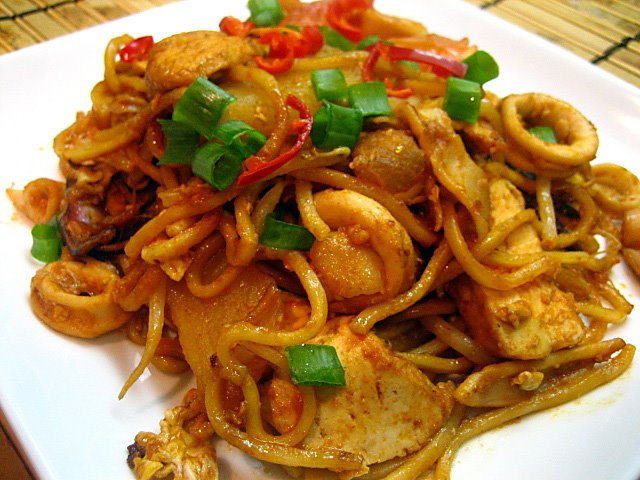
Surprisingly taking the old road to Tanjung Malim was congestion free and we made it to Tanjung Malim Yik Mun Restaurant before the lunch crowd. I know most of you love this place for the paus but we prefer their Mee Hailam, Nasi Goreng or Mee Kari instead. But just like their paus which definitely tasted better more than a decade ago, these dishes should not be ordered if Yik Mun is having a full house situation as their cooks would then be dishing out food that will definitely taste rushed and if you are unlucky enough, may even be tasteless. But like I said we were early and there were only a few other customers, so we took a chance and ordered nasi goreng, mee hailam and steam chicken rice for Along. We were well rewarded with fluffy nasi goreng in a larger than usual portion, beautifully done mee hailam and another large portion of nasi ayam. If I had known this, I would not have taken a piece of beef pau as appetizer as my nasi goring was cooked the old way, over flaming fire that you can taste the char in the rice that is just nicely oiled with enough condiments to satisfy you. Too bad that they replaced the sweet peas with long beans instead but what the heck, the taste was heavenly enough. My wife remarked that we should try to make it a practice to arrive in less crowded environs, for her mee hailam tasted just as it should and was ten years ago when she first had it. Many times since then the taste had yo-yoed, but this was just right. As usual before proceeding with the journey, we took away some chicken and kaya paus and some ground coffee, but this time I tried one cup of their Hainan kaya too. When we got to Ipoh, my kids (and surely we) loved the original eggy taste, which is how kaya should taste actually, that on the return journey we made a short stop to buy another cup. But is expensive though, RM6.50 for a tall cup of Kaya but definitely worth the taste.

We then decided to proceed all the way to Ipoh using the trunk road, since it is now basically a dual carriageway all the way. Sorry PLUS, you are not getting my money that day. On the way, we stopped at Bidor to but some petai and before Temoh I finally located the Capati Corner Restaurant that has been featured on TV and newspaper articles before. That is one stop for the journey back. Anyway we made it to Ipoh in five hours but to me it was a well spent journey as I got to show the family my paternal grandmother kampong in Chulik, Gopeng but too bad it was not durian season, as otherwise there will durian stalls along the road. In Ipoh, we went to take away sate for a gathering at my Auntie’s house in the ex railway station hawkers center beside the Perak Government offices. There are three sate stalls there but the one we liked the most is Pak Hamid’s stall, especially their sate perut which is usually sold out early and the funny thing is that even though the other two sate stalls were closed, we managed to get the sate perut in addition to the usual beef and chicken sates. What a lucky break. I bought 100 sticks at a price of RM40, I kid you not.


The next morning, we went for nasi lemak at Warong Wak in the Stadium Ipoh food court and we were joined by my sister and her husband. Then they got to talking about Matang mee udang or prawn mee near Taiping and there and then, we decided to go there for the big feast of prawns. The most famous is supposed to be Mee Udang Mak Teh but when we arrived, the place was full so my Brother In Law proceeded to another place that he wanted to try out, since usually it only opens after three p.m. and this time we were there at the right time. We ordered the mee udang, mee goreng udang and nasi goreng and when they arrived, it was definitely a sight where the mee udang and mee goreng udang was loaded with prawns. But the nasi goreng was without the same prawns as it would have been at Mak Teh’s, but what the heck, we already had enough cholesterol inducing prawns on our plate. Based on their feedback, this place dishes was more savoury and generous in their ingredients, and the Penang soup style is as we liked it as Mak Teh’s seems to be more mee rebus style. My sister also ordered a side dish of fried prawns to be eaten with white rice but my daughters shared this with her and liked it so much, that I had to order take away for their dinner also. All in, it was a fabulous feast that only cost me RM75 for a group of seven adults and four kids. Where can get that sort of prices elsewhere, as it can be easily doubled.

After that we headed into Taiping proper as mum wanted to try some of the pasembor was sister raved to her before and I wanted to try my luck on getting some proper mamak popiah that I lucked out off in previous trips there. Since I was on the lucky streak, this time I managed to get some before they were sold out a few customers after me since the other stall was closed for the day. Delicious but still I hanker for some Ipoh or Penang popiah, but in the meantime I feel satiated. Another coincidence perhaps was that on the way out we found some old style stomach or usus sate that we were talking about the night before, and we took away some to try. Not so fantastic as Sate Emas Kajang is definitely better but you cannot easily find this in Perak anymore. The only thing that was negative from this trip was that during dinner my wife found her sotong kangkung used the pasembor sauce as the dip instead of the teem cheong based sauce that is normal but I told that is mamak style, so cannot complain. Anyway dinner for me was five pieces of popiah, and that was enough and as I often told my wife, only in the north can I get away from rice as dinner, and the only way I can eat right.

So the next day we only had a light breakfast since I wanted a real one at the capati place I mentioned above. So detouring out the Gopeng exit after topping up the Touch N Go card, we had another slow journey along the trunk road as we need to look out for the place. When we arrived, I had their coffee with fresh unskimmed milk or kopi kepala as you get the layer of fat on top, very nice but made me too sleepy to drive later. Their capatis were good but was over hyped methinks so next time I want to try the other capati place across the road where the road warriors or the lorry men seems to be stopping by instead. Since we wanted another cup of kaya, we proceeded by the old road again to Tanjung Malim, stopping at Bidor for cikus, jambu madu and mangosteen this time. Once we arrived in KL it was lunch time and since we had to do some business in Lebuh Pasar, I took my family to a café that I frequent there where they loved the nasi gorengs. But this place I shall review for the next time as I will only talk of the rediscoveries I made on this journey.

Wednesday, 30 May 2007

Lest We Forget

I just found out....there is no easy reference for decommissioned RMN ships before and after Merdeka. So for those interested, check this out.

HISTORY OF THE ROYAL MALAYSIAN NAVY

The Royal Malaysian Navy has her origins from the Straits Settlement Naval Volunteer Reserve (SSNVR) which was established with 54 Malay volunteers to assist the Royal Navy in the defence of the Straits and Malay states territorial waters. The SSNVR was formed in Singapore on 27 April 1934 and was initially located at the Singapore Volunteer Corps Headquarters. On 18 January 1935, the British Admiralty presented her with a WW1-era Flower-class escort sloop, the HMS Laburnum, to serve as the Reserve's Headquarters and drill ship that was based at Teluk Air Basin, Singapore. This unit was later expanded with a Penang branch established in 1938 and was subsequently renamed as the Malayan Royal Navy Volunteer Reserve (MRNVR).

HMS Laburnum - The pride of the MRNVR

As World War II approached, the British quickly formed a Malay Section of the Royal Navy with the absorption of MRNVR members and fresh recruits. Established on 4 September 1939,it was called the Royal Navy Malay Section or simply as the Malay Navy. The section was based at HMS Pelandok training camp in Sembawang naval base, Singapore. The Malay Navy expanded rapidly from 400 men in 1939 to 1430 men in 1941. However, at the outbreak of the war, only 158 British officers and 650 local seaman remained as the others had finished their contract by that time. When Singapore fell to the Japanese in 1942, only about 150 men of the Malay Navy were safely evacuated to Ceylon (Sri Lanka), East Africa and India. These men later returned with the Liberation Force in September 1945 and a total of 650 men reported back for duty after the war. Unfortunately, due to post-war financial constraints, the Malay Navy was disbanded in April 1947.


HMS Test became the nucleus ship of the Malayan Naval Force

At the outbreak of the Communist Emergency, the Malay Navy was reactivated on 24 December 1948 when the Malayan Naval Force regulation was officially gazetted on 4 March 1949. The main function of the Malayan Naval Force(MNF) was coastal patrol in order to stop the communist terrorists from receiving supplies from the sea. In addition, the Force was tasked with guarding the approaches to Singapore and other ports. The MNF was based at an ex-Royal Air Force radio base station in Woodlands, Singapore. that was initially called the 'MNF Barracks' but was later renamed as the HMS Malaya.

HMS Pelandok of the MNF

The MNF was firstly equipped with a River-class frigate, HMS Test that was used as a training ship but by 1950 had in service an ex-Japanese minelayer HMS Laburnum, a Landing Craft Tank (LCT), HMS Pelandok, motor fishing vessel HMS Panglima, torpedo recovery vessel HMS Simbang(Erratum) and several seaward defence motor launches (SDML). The vessels of the Force were later renamed with the prefix Malayan Ship(MS) to differentiate them from Royal Navy units.

The main patrol units of the MNF are SDML's like above

In May 1950, the deactivated Battleship HMS Malaya ship's bell was presented by the The Royal Navy to the MNF as a mark of honour and appreciation for their service. The Malayan Naval Force was again honoured when in August 1952 Her Majesty Queen Elizabeth II, bestowed the title 'Royal Malayan Navy' Singapore to the MNF in recognition of her sterling service in action during the Malayan Emergency. The navy's ships now carried the prefix Her Majesty's Malayan Ship(HMMS) and subsequently flew her own white ensign on 31 December 1956.

HMMS Penyu was one of the larger vessels in the MNF fleet

The Royal Malayan Navy Singapore that was then still part of the Royal Navy, was eventually transferred to the independent Federation of Malaya on 12 July 1958 and renamed the Royal Malayan Navy(RMN). With the hoisting of The Federation naval ensign eleven days later- the White Ensign modified by the substitution of the Union Jack with the Federation flag in the upper left corner- the RMN was thus made responsible for Malaya's maritime self defence. The new navy bravely shouldered the responsibility with only an operational and training base at HMMS MALAYA and a small coastal fleet of 1 LCT, 2 Ham-class inshore minesweepers, 1 coastal minelayer and 7 SDML's on free transfer from the Royal Navy. In the first year of independent service, it was decided to rename all the ships in the fleet according to the names of the Malay states. On 3 November 1961, the young navy was again honoured when it was declared that her ships were now to be called with the Malay prefix Kapal Diraja(K.D.) as a mark of her independence since the use of HMMS was considered as a relic of colonialism. The new prefix also established the navy's national identity for the first time.


KD Hang Tuah was the first frigate class warship the RMN had

With the formation of Malaysia in 1963, the Royal Malayan Navy became known permanently as the Royal Malaysian Navy. However before the new navy had a chance to be strengthened, it had to face her first conflict in the confrontation(Konfrontasi) with a superior-equipped Indonesia over its objection to the formation of Malaysia. Fortunately, the Royal Navy maintained a massive deployment throughout the conflict as a shield in defence of her former colony. To face the challenges posed by the Indonesians, the RMN was further developed with the assistance of the British. Therefore in the mid-Sixties, the modest Royal Malaysian Navy's inventory comprised entirely of British-supplied ships: one ex-Royal Navy Loch class frigate, four Ton-class coastal minesweepers, four Ham-class inshore minesweepers, 10 Kedah/Sabah class Vosper patrol boats and a newly delivered LCT, in addition to the remaining 3 ex-MNF SDML's. These ships put the RMN in the forefront of the defence of Malaysia by securing her territorial waters and assisting the land forces in their operations against the Indonesian infiltrators.


The KD Sri Langkawi was the forerunner of the navy's amphibious force.

The RMN continued not only to develop her assets throughout the Konfrontasi but also gained operational knowledge and experience from the conflict. This resulted in the RMN being entrusted to assume the responsibility of patrolling Sabah and Sarawak waters from the Royal Navy in 1966, one month after the conclusion of the confrontation with Indonesia. Having now learned of the need for constant preparedness, a gradual process of development was begun in order to ensure the navy is sufficiently equipped to face any challenges. To expand the range and firepower of her naval assets, the RMN purchased larger Kris class patrol boats and a squadron of Perkasa class torpedo fast attack craft (FAC-T) which all entered service by 1968.

Minesweepers like KD Brinchang also played a patrol role for the navy

However, the gradual development program changed following regional turbulence and the strategic withdrawal of the British Armed Forces from the region in the early 1970's. These events resulted in the implementation of the Armed Forces Special Development plan whereby the RMN operational strategy changed from one of coastal defence and law enforcement within territorial waters to a strategy of sea denial to the enemy, long-range patrol, monitoring, ensuring safe navigation against low-level threats (piracy) and escort and strike missions. The navy duly began a rapid force level expansion where landing ships, frigates and FAC squadrons were added to the Fleet. The RMN had also at this time entered the missile age with the retrofitting of the Perkasa FAC's with Aerospatiale's SS-12M missiles in 1971 and the acquisition of one Exocet missile armed fast attack craft squadron a year later.


Perkasa class signalled the modernisation of the Navy


This decade also marked the diversification of naval assets procurement away from Britain, the navy's traditional supplier when the French, Germans, Swedes and Americans also managed to supply their vessels and equipment to the RMN. The trend away from dependence on the British was further advanced by the assumption of full operational control of the navy by local personnel during the period. The RMN now faced the challenge of proving the capabilities of her local crew in running their own navy without expatriate commanders. Nonetheless, through a historical quirk the RMN still faced a unique problem of a sovereign nation who's navy and her major command and training facilities were stationed in another sovereign's territory, Singapore that had seceded in 1965, and not within Malaysia itself. In concert with these developments, the RMN established her own major base in Lumut in 1979 and fully shifted her fleet operations from the leased facilities in Woodlands, Singapore two years later. Next, two German made FS1500 Frigates, two Multi-Purpose Combat Support Ships, two Off Shore Patrol vessels and four Mine Countermeasure Vessels(MCMV) entered service in the 1980's, contributing to the enhancement of the RMN's fighting capability. However, the economic slowdown faced by the nation in the middle of the decade forced the cancellation of the planned acquisition of a follow on order of two each of FS1500 frigates and MCMV's. As most of the major vessels in the fleet are helicopter capable, a naval air wing was also established in 1988 with Wasp ASW Helicopters, making the navy one of the few in the region to be so equipped.


With an improving economy and a shift in strategic requirements, the RMN from 1991 changed their operational objective from a threat-based force to a capability-based force. Therefore in the nineties the RMN took delivery of four Laksamana class Corvettes and two UK built 'stealth' frigates to enable the navy to play a more offensive role in three-dimensional warfare. These programs were carried out as part of the process of transforming the RMN from that of a brown water navy into a navy capable of performing and carrying out extended blue water operations. The reason being Malaysia's geography requires the navy to have sufficient reach and capabilities for offshore surveillance and coastal defence. This is to ensure her effectiveness and the continued relevance of the navy in her dual function as a fighting force as well as a maritime law enforcement agency. As such, even though the Royal Malaysian Navy has had a chequered history of development, she can now face the future with confidence as the navy has been sufficiently modernised to face the challenges of the new millennia. The RMN can now stand proud as a navy to be respected, that can give as good as he gets.

Friday, 25 May 2007

The Wait Is Finally Over


Finally the wait is over to receive the first two units of the RMAF SU-30 MKM after four years the purchase agreement was signed. The puzzle concerning the fighter's camouflage scheme has also been answered as a light blue on grey colour scheme has been displayed. Whether the RMAF will adopt a similar gunship grey colour scheme similar to their other fighter assets we will see later. And finally we have confirmation from the PTU himslef that the MKM will be armed with a BVR missile the Amraamski that has been a point of conjecture by the project's keen observers since some of the region's air forces has such BVR armed fighters. And it looks like the AEWC aircraft purchase may be put on hold since the fighter's AEW capabilities has been strongly featured by the PTU, possibly as a salve to soothe fears that the RMAF has no organic AEW capabilities.

Anyway it looks like Gong Kedak Air Force Base near the Kelantan will be a favourite spot for aircraft spotters once the first two birds lands there next month. I am all for it so that photos of the birds will now populate the cyberspace as they have been very difficult to spot in deed, Anyway for those of you interested to view the video the MKM roll-out, point your browsers to this link

Thursday, 24 May 2007

If They All Come from Chennai

Nasi Ganja Ipoh

Recently my auntie passed away in Ipoh and as part of the ritual for my immobilised uncle, I went and bought their favourite murtabak at the Ipoh Godown Kanteen in front of ICT. While waiting I heard one of the brothers has gone back to Chennai and that got me thinking, if the mamaks basically come from Chennai why are their recipes so different from each other. Case in point is their murtabak which is one of the rotis i missed out on my previous posting, maybe because it is easier for me to find good ones still. Their murtabak is still done in the old way, a mix of curried meat with onions and eggs, poured onto a piece of dried roti canai and let cooked on one side, before being turned and then the balance of the mix is poured onto the other side before being wrapped in roti canai and at the end brushed with ghee while cooking before being served. Quite different from the way it is done nowadays and this way you get the murtabak in layered form, a bit like lasagna and more filling than that of a grandised roti telur.


Talking about nasi kandar, I don't really eat this other than outside of Ipoh maybe because there are many other food options for me there. I only go to the mamak shops near my house but if the appetite strikes me, then I will go for the famous 'Nasi Ganja" in new town. This is unlike typical nasi kandar as they serve old style nasi kandar with coconut sambal/chutney. Where can find like this nowadays eh. My brother likes their ayam panggang but my hantu dish is definitely their daging masak hitam. The funny about me is I prefer to tapau their nasi than eating at the shop. You want to know why? It is because for me all the lauk and nasi becomes 'mesra' after being packed for some time, so the taste becomes one heh!heh!heh! The last time time i was there, I packed a few ayam panggangs, daging hitam and three udang besar and it only cost me less than RM50. No way I can get such pricing in KL. But anyway the fact is that in a town like Ipoh, there are so many ways nasi kandar is served, and that is not even talking about the various nasi kandar in Penang itself, where everyone has their favourite spot. So I do not want to go there :) And the most obvious thing to me is that nasi kandar in Malaysia seems to have two versions, the northern style starting from Perak onwards, and the rest like they have in KL southwards. I must say that I find the southern style less spicy and with less kick, and the only nasi kandar stalls that I really like are at Medina Restaurant in BB Plaza rooftop food court and previously the stadium nasi kandar(i do not know where they have gone nowadays, bummer). The other nasi kandar places I go only because it is near or because they serve good fish head curry, but this can be a talked about in a different post right.

What I will write about though is the pasembor. In the old days of Ipoh Padang, you can find many pasembor stalls bawah pokok manned by mamak chennai with different recipes , and it is up to you to choose which preparation you prefer. Again I personally like those available near my housing estate, but to this day only one stall has survived and that is because the owner has put down roots in Ipoh rather than balik kampung with his sons now taking turns manning the stall. Their mee mamak is also excellent. If you do not know, mee mamak is basically fried mee where they add chilli paste, vinegar and the pasembor gravy to the fry mix, that also includes the pasembor kueh or fritters and boiled potatoes. I prefer the dark version with extra soy sauce but usually you get the red version due to the chilli paste and gravy mix. But again the recipes seem to differ in the north and south. Most mee mamak south of Perak seems only to use chilli boh or paste in their preparation and only add light soya sauce. You can only find the fritters or boiled potatoes very rarely and there usually is no vinegar bite. So here usually you find red coloured mee mamak instead.


Well I believe you will notice that my main grouse between the northern mamak food and the southern version seems to be ingredients, or rather the lack of ingredients. In that case you have hit it on the spot and on that note I shall end, Ok.

Thursday, 17 May 2007

Then and now – Roti Edition

Some of you may have noticed that I waxed lyrical on some nostalgic Malay dishes in the Malay language in several of my previous postings. The reason for this is that only by writing in Malay can I do justice to their memories but I hope that now I can do the same for this topic in English.
Now I know many people especially the younger set may not know that their favourite roti canai or parathas as some may call it was originally prepared with ghee in the dough and then fried with a mix of liquid ghee and vegetable oil, bringing the taste of the humble roti canai to the Nth degree. When prepared this way, the roti canai becomes so flavourful and fluffy, very unlike the stiff rotis masquerading as roti canai in some places these days that if thrown at a brick wall, a dent is the result. And what’s more, if the ghee roti canai is tapaued in banana leaves like my father used to do in my childhood days or served on one, I can guarantee you that the taste and smell is so heavenly that even eating it cold with just sugar is syiok enough. No need for the usual curry, dalcha or parpu and definitely you will not ‘banjir’ it to soften the hard rotis as so often the case is nowadays, as that defeats the point as you lose the taste. Aha I see some of you scratching your head wondering what the heck is parpu. Well in the north where you can still get fluffy roti canais but alas without the ghee, parpu is the simple yellow lentil curry that has been subtly spiced to perfection. A very good ‘training’ condiment for the kids. Although you can still find parpu in the Klang valley in shops that betray their northern origins, like the ghee roti canai both have gone the way of the dodo. This methinks is basically due to economic costs as I suspect by replacing the parpu with dalcha curry allows the shop to offer a dish that can last till dinner and the morrow perhaps. However I was lucky enough in one of my recent balik kampung trip to the wife’s village in Rantau, the mamak shop proprietor there was kind enough to make the roti canai with ghee after hearing me reminisce about how it was prepared in the old days. The funny thing was that although he initially wanted to charge extra when I made the order, he forwent the surcharge when he revealed he was also a displaced northerner and pined for the old ways. I suspected as much since he had parpu anyway but at least my family managed to get a taste of what I have told them many times before.

Next I would like to remind you of a dish that supposedly originated in Singapore but now is found everywhere locally, a fact that I shall not contest because I personally first tasted it over there umpteen years ago. This is the Roti John, basically sliced baguette halves topped fried with a mix of egg and spiced minced meats, reassembled and served with cucumber slices and chilli sauce. I have no idea if the roti john over there remains the same nowadays, but the version we have here is a far cry from the original. What we have now is to me just French toast made with hot dog rolls, and some sweet rolls no less and usually there is no meat at all. Although there are still pockets of holdouts if you are lucky enough to find them, the bread used are still hot dog rolls. (Come to think of it, the large roti john rolls would be perfect for foot long hot dogs don’t you think). The closest to the original taste I had recently was at restaurant Apple Burger in Bandar Baru Melaka, but unfortunately I failed to see if they still make it the original way in Klebang, as it seems it now only opens at night. But I will try my best to have this the next time I am in Melaka, as Melaka is reputed to be only the other place that used to serve real roti johns and I hold out the hope that the bread shall be baguettes.


As it is I am glad that traditional style kopitiams are now making a comeback and I pray that it will not be a passing fad. At least I can get again real roti bakar, made with roti benggali, butter (no margarine mind you) and seri kaya, albeit at inflated prices. You have to pay the cost of progress I guess. Now to those of you who think that roti bakar made with sandwich bread, margarine and factory made kaya is the real thing, you have my sympathies. Real roti bakar must be made of thickly sliced fluffy bread or roti benggali, grilled on the pan or charcoal grill if you are lucky. Those toasted in toasters are just that my dear, plain old toasted bread and undeserving of the moniker roti bakar. And you better make sure it served with butter cut from the block and homemade seri kaya, otherwise you will not be in roti bakar heaven. You can see the butter peeking from the photo, and that is how it should be made.


While we are at these most Malaysian Chinese of bread, shall I touch on the difficulty for a Moslem like me to get good halal cakoi that I can get easily in my hometown? Over here the ones made by the Malays are not as flavourful or fluffy, something to do with the air kapur that is usually deleted in their recipes methinks, and once cold becomes pitiful chewy things. How I salivate when passing pass Chinese cakoi stalls that over here I do not dare to buy from, as they are not as sensitive to Moslem needs as in the north. There used to be a good one sold by a Malay man hailing from Taiping, but he no longer sells at the old location so it is a lost cause for me. So if you know of one, kindly drop me a line okay.

Have any of you heard of cream horn? This is a hard pastry shell shaped like a spiral horn with the most delicious white cream filling. In Ipoh when the roti man comes around these will be bought as a treat, either as a reward by my parents or with my hard earned savings. Fortunately my own roti man does bring some around if I am lucky, and I will buy a whole pack of five to savour or share it with my sister in Bangi. Yet our kids do not seem to take to it though, so it may be that cream horns will only be comfort food for my siblings. Continuing the theme of now and then, those that my roti man brings are quite true to the original version, but again the buttery taste of the pastry is quite negligible, another victim of economics. And the most common ones available nowadays usually have custard fillings instead and shouldn’t these be called custard horns instead right?

Well talking about custard fillings, custard puffs or romsus as my family calls it is another extinct species of roti. I remember that each time a family member travels to Penang, a box of romsus is a compulsory souvenir as we consider the best comes from there. But these started disappearing in my teens and nowadays is a hit and miss affair to find them. The funny thing is that cream puffs are now easy to find, so it seems cream horns and custard puffs have switched their fillings. Nonetheless recently I had my fill of custard puffs at my dear friends’ barbecue party as the wife comes from Penang and she made it right, oh so so right. That should appease my longings for a while.

I cannot think of other roti to finish on but I would like to end by saying that if you have the time and find yourself traveling the Cherating trunk road northwards in the evening, once you pass the resort area do keep a sharp look out for a small crude sign that says “roti panas” in front of a decrepit wooden house along the road. If it is your lucky day, it will be baking day, as the alternate days are the days when the baker makes his own seri kaya. This is used as the filling for the most utterly delicious wood baked buns filled with the aforementioned seri kaya, red bean paste, coconut candy or sweet milk buns. Bite into one and you are biting into heavenly roti and would now understand the loss I feel for roti now and then. But hurry up, the baker is old and his treasures may be lost to mankind anytime soon.

Wednesday, 16 May 2007

Is it so wrong to build the new frigates at LSE

In the month of July last year, the Malaysian Government announced that they were negotiating with BAE to build two additional Lekiu class frigates in upgraded version optimised as Air Defence ships to be called Batch 2. The Defence Minister announced that one of the conditions negotiated was for these ships to be built at Labuan Shipyard Engineering (LSE) to provide employment opportunities for the are and also to develop shipbuilding skills of the nation. Even before the announcement has died down, many critics voiced out their opinions that the Kedah class building debacle will be repeated, that is the program will be in fits and starts especially since the Batch 1 program itself was delayed in their delivery for several years. This forced the Minister to issue a statement that (sic) " Malaysia will learn from the previous experience in implementing the construction project of the two new frigates" a week after the announcement.

Nonetheless the critical voices continued, especially when it was announced that BAE has signed an MOU with the company Realmild, owner of LSE for the project. They said that this is another political project headed for trouble as they claim that Realmild is a subsidiary of the politically linked Media Prima entertainment local giant and has no shipbuilding experience. Hello everybody, do you know that Media Prima's management board has been successful in turning around a company that was at land's end due to the economic crisis and has now become a corporate giant again. And this was a management group that had no media industry experience in the beginning but with striving efforts they did it. That's just it, in business you need able management, not expertise in a particular industry as such expertise can be learned and LSE foremostly needs turning around and thus I am confident that this project will work out.

Some also says that the nation cannot afford to have two naval shipbuilders but do they understand that we actually do not have any naval shipbuilding specialist. Boustead Naval Shipyard also builds civilian vessels to ensure good revenue as no one can survive by just depending on MAF purchases only. Anyway, with two dockyards that can support naval shipbuilding at both ends of of maritime nations divided by the South China Sea, it would certainly help the RMN to obtain support services for the vessels but this fact is also disputed. But can anybody deny the fact that both our premier front-line vessels has been dry docked at the same time?

The best thing, there are also accusations that this project was not properly planned and done hastily. They cannot accept the fact that the project has been well planned by all parties to ensure it is sustainable and viable. One thing I really like is that part of the conditions in the LOI awarded are that BAE must establish sufficient facilities and ensure transfer of technology is carried out BEFORE the purchase agreement is concluded. This is different than before where TOT is usually an afterthought or even neglected that many such manufacturing programs faces problems as the seller may stop the transfer of capabilities, especially if there are delays in payments. In other words, this is not business as usual, because if the conditions in the LOI is not followed including preparing sufficient facilities for local construction, the sale itself will not be pursued. This is why I believe the project will go well. Don't tell me that Datuk Shahrir will keep quiet if there are any hanky-panky in such a high profile project.